
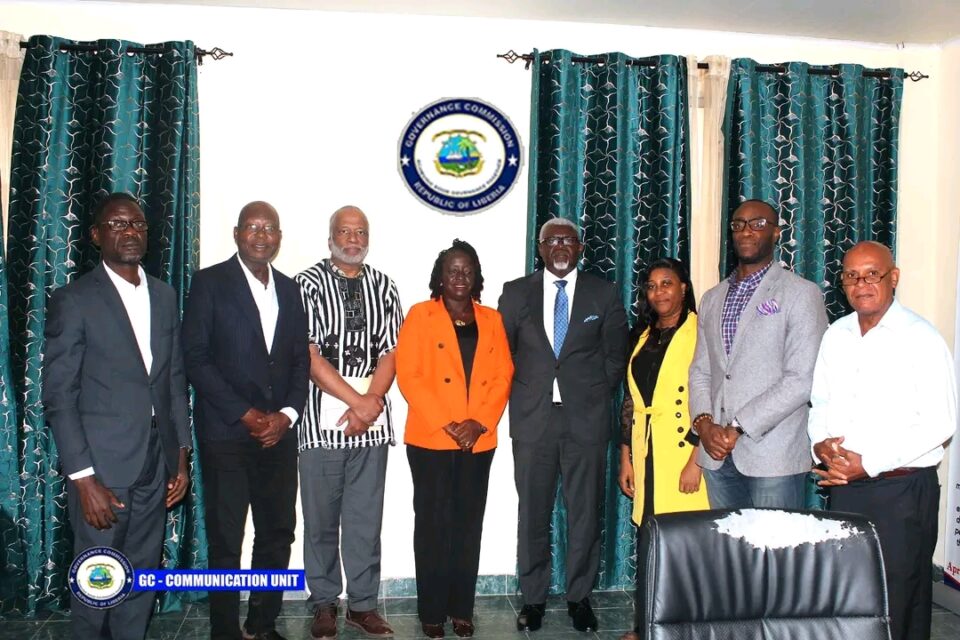
Monrovia, Liberia – The Governance Commission (GC) has taken a significant step toward implementing President Joseph Nyuma Boakai Sr.’s directive to relaunch the Liberia National History Project (LNHP) following a high-level meeting with Dr. Herbert Brewer, National Orator of Liberia’s 179th Independence Day celebration, and Hon. Nathaniel Kwabo, Director General of the Cabinet.
The meeting, held on Tuesday, focused on translating the President’s vision into concrete actions aimed at rewriting and preserving Liberia’s national history through an inclusive, Liberian-led process.
The Liberia National History Project traces its roots to the recommendations of the Truth and Reconciliation Commission (TRC) in 2009, which called for a comprehensive and balanced account of Liberia’s history to promote national healing and reconciliation. The TRC argued that the country’s historical narrative had been fragmented and often excluded the experiences of indigenous communities and other marginalized groups.
The initiative was officially launched in 2013 with support from UNESCO and the Government of Liberia. The Governance Commission was tasked with leading the process, coordinating research, national consultations, and policy discussions involving historians, anthropologists, governance experts, and other scholars.
The project produced several research papers examining Liberia’s political development, governance, social divisions, inequality, constitutional reform, demographics, and environmental issues.
Although the project achieved important milestones—including nationwide consultations, engagement with the Liberian diaspora, and the production of analytical studies—it struggled to maintain momentum.
Limited financial support, inconsistent government funding, and inadequate institutional capacity prevented the project from producing history textbooks and integrating its findings into the national education system.
These challenges eventually stalled implementation.
President Boakai Revives the Initiative
The project received new life during Liberia’s 179th Independence Day celebration in Buchanan, Grand Bassa County, where President Boakai officially announced its revival under the theme, “Strengthening National Identity Through Liberian-Led Historical Leadership.”
In his national address, the President emphasized that the work should be led by qualified Liberian historians, archivists, archaeologists, anthropologists, linguists, educators, and other experts.
He stressed that Liberia’s identity is rooted in the contributions of indigenous civilizations, freed Africans who returned from the Americas and the Caribbean, and the country’s enduring relationship with the African diaspora.
“The strongest nations are united by shared values, common purpose, mutual respect, and a deep sense of identity,” President Boakai declared.
The President also announced plans to collaborate with international universities, libraries, and cultural institutions to recover historical records relating to Liberia.
Additional measures include modernizing the National Archives and National Museum through digitization, restoring the Kendeja Cultural Center, and establishing an intergovernmental technical committee to oversee implementation.
Governance Commission Commits to Action
During Tuesday’s meeting, Acting Governance Commission Chairperson Prof. Alaric K. Tokpa welcomed Dr. Brewer and Hon. Kwabo, describing their visit as a clear demonstration of the administration’s commitment to preserving Liberia’s history.
Hon. Kwabo reaffirmed President Boakai’s full support for the initiative, assuring the Commission that the Executive Branch remains committed to ensuring the successful implementation of the National History Project.
Dr. Brewer also pledged his continued involvement, emphasizing the importance of sustained collaboration among government institutions, scholars, and other stakeholders.
Commissioners used the meeting to share ideas on strengthening the project, with discussions centered on producing an inclusive and accurate historical record capable of promoting national unity, reconciliation, and identity.
One of the key outcomes of the meeting was the decision to organize a National History Conference, which will bring together historians, policymakers, academics, and civil society organizations to develop a roadmap for implementing the Liberia National History Project.
The revival of the Liberia National History Project represents far more than a historical research initiative. It is a nation-building effort intended to strengthen Liberia’s identity, promote reconciliation, and ensure future generations have a more complete understanding of the country’s past.
With strong presidential backing, renewed institutional commitment, and the active participation of Liberian scholars, the Governance Commission believes the project now has a solid foundation for success.
As Liberia approaches the centenary of significant historical milestones, including the 1926 Firestone Concession Agreement and the Harvard African Expedition, the renewed initiative presents an opportunity for Liberians to take the lead in documenting and preserving their own history.
The momentum generated by the Independence Day celebrations and reinforced by Tuesday’s high-level meeting signals a renewed national commitment to ensuring Liberia’s historical narrative is researched, preserved, and told through Liberian voices.
