
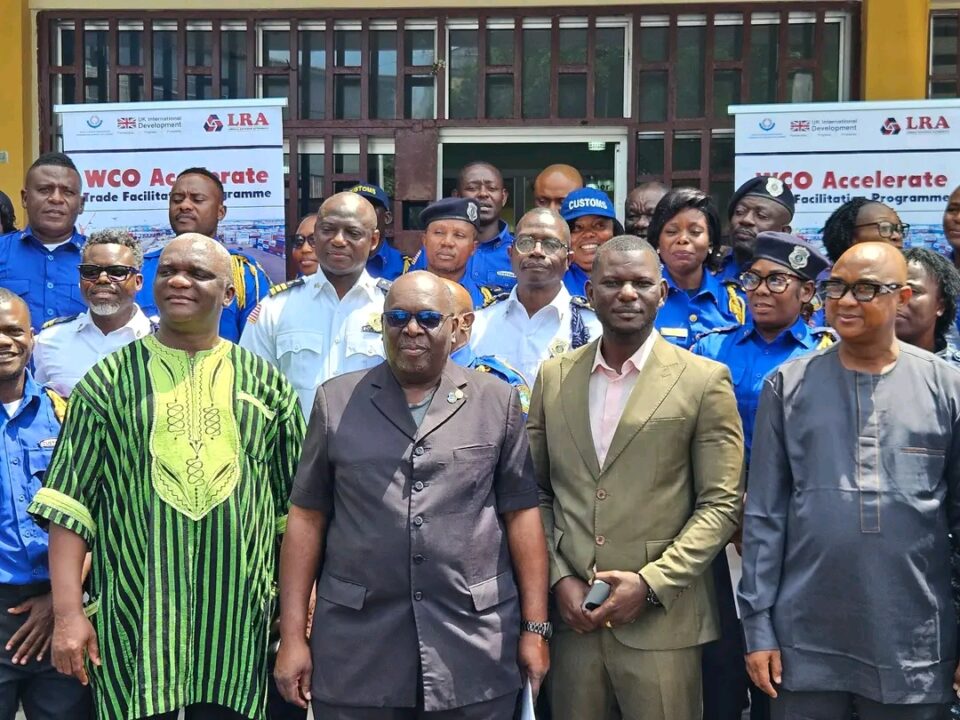
Monrovia, Liberia – The Liberia Revenue Authority (LRA) has launched the country’s second National Time Release Study (TRS), revealing that it currently takes an average of 12 days, 19 hours, and 42 minutes for imported cargo to move from vessel arrival to final exit at the Freeport of Monrovia.
Speaking Monday at the Liberia Chamber of Commerce in Monrovia, LRA Commissioner General and Chief Executive Officer Hon. James Dorbor Jallah described the report as a turning point in Liberia’s drive to modernize customs administration, improve trade efficiency, and strengthen economic growth.
Jallah said the study is not merely a technical assessment but a national commitment to transparency, accountability, and reform.
”This is more than the presentation of a document. It is a statement about who we are as a nation—a people unafraid to measure ourselves honestly, confront our challenges squarely, and solve our own problems with determination and the support of true friends,” he declared.
The study, conducted using the World Customs Organization (WCO) internationally accepted methodology, analyzed 670 import declarations, exceeding its original sample target and covering every stage of the import clearance process—from vessel arrival to cargo exit.
One of the report’s most significant findings is that customs inspections themselves account for only a small fraction of the overall clearance time. According to the findings, joint inspections by Customs and partner agencies take less than one hour on average, while processing at the port exit gate requires only about 34 minutes.
Instead, the report attributes the bulk of delays to bottlenecks outside Customs, including late submission of shipping manifests, manual documentation, delayed payment confirmations, and poor coordination among stakeholders such as shipping lines, commercial banks, brokers, transporters, and regulatory agencies.
”The delays do not lie in the diligence of our officers,” Jallah emphasized. “They lie in the spaces between institutions.” To address the identified challenges, Jallah announced an ambitious package of reforms aimed at dramatically reducing cargo clearance time.
Central to these reforms is the construction of a modern Destination Inspection Facility at the Freeport of Monrovia. The facility will house Customs and other clearance agencies under one roof and utilize advanced non-intrusive inspection technology to streamline examinations and eliminate duplication. The LRA is also upgrading the ASYCUDA World customs management platform, which will be integrated with the Central Bank of Liberia, commercial banks, and the Liberia Integrated Tax Administration System (LITAS).
The upgraded digital platform will enable real-time electronic payment confirmations, online declarations, and automated cargo releases, replacing the current reliance on paper documentation.
According to Jallah, the modernization effort will also serve as the foundation for Liberia’s future National Single Window, allowing all trade-related government agencies to operate through one integrated digital platform.
A technical team from the United Nations Conference on Trade and Development (UNCTAD) is currently supporting the implementation process.
While reaffirming the LRA’s commitment to reform, Jallah stressed that improving trade facilitation requires collective action from every institution involved in cargo clearance.
He called on shipping companies to submit manifests electronically before vessels arrive, urged APM Terminals Liberia to accelerate cargo discharge and fully digitize Terminal Delivery Orders, and encouraged importers and customs brokers to submit accurate declarations promptly.
He also appealed to government agencies to deepen coordinated border management to eliminate unnecessary delays. ”The clearance of a container is a relay race,” he said. “A relay is only as fast as every runner and every handover.”
Jallah said the reforms are fully aligned with President Joseph Nyuma Boakai’s ARREST Agenda for Inclusive Development and the LRA Corporate Strategic Plan (2025–2029), which prioritize digital transformation, efficient public service delivery, and increased domestic revenue mobilization.
He noted that reducing cargo clearance time will lower the cost of doing business, improve Liberia’s competitiveness, attract investment, strengthen revenue collection, and ultimately benefit consumers through lower prices and improved market efficiency.
The LRA boss expressed appreciation to the World Customs Organization, the Government of the United Kingdom through His Majesty’s Revenue and Customs, UNCTAD, the European Union, the National Port Authority, APM Terminals Liberia, the Liberia Chamber of Commerce, and members of the National Trade Facilitation Committee for their financial and technical support. He also commended Customs officers, technical experts, and private-sector stakeholders whose contributions made the study possible.
Jallah pledged that the LRA will continuously monitor implementation of the study’s recommendations through a time-bound action plan and performance framework.
”We will measure our progress quarter by quarter, indicator by indicator, until the next Time Release Study confirms what we know Liberia can achieve together,” he concluded.
The National Time Release Study establishes Liberia’s first internationally recognized benchmark for measuring cargo clearance performance and is expected to guide future customs reforms aimed at accelerating trade, improving border efficiency, and positioning Liberia as a more competitive destination for regional and international commerce.
