
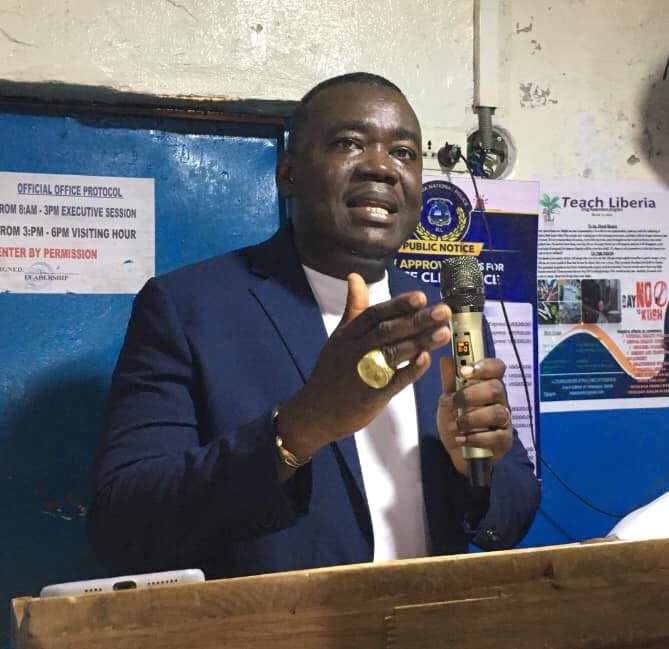
By Pewu Y. Sumo
MONROVIA — The Liberia Institute for Strategic Studies and Development (LISSD) was officially launched on Wednesday, September 30, 2026, at the Center for the Exchange of Intellectual Opinion (CEIO) in Monrovia, with Founder and Executive Director Tamba Ralph Brown calling for a transition from political activism to independent, evidence-based policymaking grounded in credible data.
Delivering keynote remarks, Brown stated that LISSD was established to address severe gaps in national data collection, policy research, and concession oversight. He criticized Liberia’s historic reliance on external organizations like the World Bank to provide baseline figures on poverty and unemployment, highlighting the role of LISSD and the urgency of building domestic capacity to generate credible data and evaluate national development strategies.
Brown said budgetary reform, concession agreement oversight, operational frameworks, the Liberia Governance Index, and strategic partnerships are where LISSD fits into data-driven policymaking.
He argued that there are concerns over the national budget structure, where roughly 70% of resources are consumed by recurrent expenditures such as government salaries and operations, rather than direct public investment.
Brown noted that there is a need for independent monitoring of major extractive and natural resource agreements—including long-term contracts with companies like ArcelorMittal and Bea Mountain—to verify compliance with contractual terms and ensure local communities benefit.
LISSD, a think tank headquartered on Randall Street in Monrovia, will operate across six core programmatic areas, producing comprehensive regional outlooks, peer-reviewed reports, and data-driven recommendations through international partnerships.
The LISSD executive director announced the rollout of an annual “Liberia Governance Index” to independently monitor anti-corruption efforts, judicial integrity, and institutional adherence to the rule of law.
Brown, however, emphasized a non-confrontational, collaborative model aimed at building formal partnerships with government agencies, civil society organizations, the Press Union of Liberia (PUL), and CENTAL.
The LISSD launch closed with a call to stakeholders and public officials to safeguard Liberia’s democratic stability by embedding evidence and strategic planning into national governance, with some CEIO members expressing willingness to offer voluntary service to the newly established institution.
