
By Sally S. Bryant Jr.
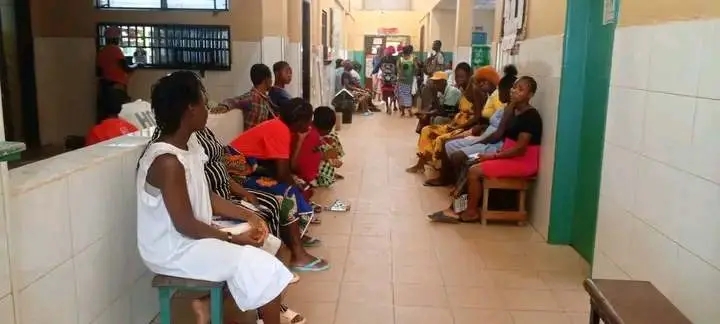
GBARNGA, Bong County — C.B. Dunbar Hospital is struggling to cope with an overwhelming influx of patients triggered by the ongoing strike at Phebe Hospital, forcing administrators to convert the facility’s conference hall into an emergency patient ward as bed space reaches critical levels.
Hospital Administrator Enoch Morris said the hospital has remained fully operational since health workers at Phebe Hospital began their industrial action, but the suspension of services at one of Bong County’s largest referral hospitals has placed C.B. Dunbar under extraordinary pressure.
In an interview with reporters, Morris disclosed that patient admissions have surged dramatically over the past 48 hours, stretching the hospital’s capacity beyond its limits and placing immense pressure on healthcare workers, medical supplies, and available infrastructure.
“We have been very overwhelmed with patient flow between yesterday and today,” Morris said. “The number of patients coming to the hospital has exceeded our available capacity, and we are doing everything possible to ensure that no one is turned away.”
According to Morris, C.B. Dunbar was originally established as a maternity hospital before being upgraded to a full-service hospital in 2021. However, while its responsibilities expanded, its physical infrastructure did not, leaving the facility ill-equipped to handle the growing healthcare demands of Bong County.
The hospital currently operates with 102 functional beds, which are routinely occupied even during normal periods. The ongoing disruption at Phebe Hospital has now pushed the facility beyond capacity, leaving management with no option but to activate emergency measures.
Among the immediate interventions, hospital authorities, working closely with the Bong County Health Team, have converted the hospital’s conference hall into a temporary general ward to accommodate the increasing number of patients. Stable patients are also being transferred to alternative spaces to free beds for emergency and critically ill cases.
Morris described the situation as unprecedented, warning that the emergency measures are only temporary solutions to a much deeper healthcare infrastructure challenge facing the county.
“The current situation has exposed the vulnerabilities within our healthcare system,” he said. “Even when both C.B. Dunbar and Phebe Hospital are fully operational, our facilities struggle to meet the healthcare needs of Bong County’s growing population.”
He renewed an urgent appeal to the Government of Liberia and its development partners to expedite the construction of the proposed new C.B. Dunbar Hospital along the Lofa Road, describing the project as essential to improving healthcare delivery and strengthening the county’s emergency response capacity.
Morris stressed that while the completion of an annex currently under construction at C.B. Dunbar later this year will provide some relief by expanding patient space, it will not be enough to address the county’s long-term healthcare needs.
He expressed hope that services at Phebe Hospital would soon resume but said the ongoing crisis should serve as a wake-up call for policymakers to prioritize investment in modern healthcare infrastructure capable of withstanding future emergencies.
The developments come as health authorities continue to monitor the impact of the strike at Phebe Hospital, with C.B. Dunbar Hospital now carrying much of the burden of providing medical care to patients from across Bong County and surrounding areas.
The crisis has renewed concerns over the resilience of Liberia’s healthcare system, as the disruption of services at a single referral hospital has exposed the limited capacity of neighboring facilities to absorb a sudden surge in patient demand.
