
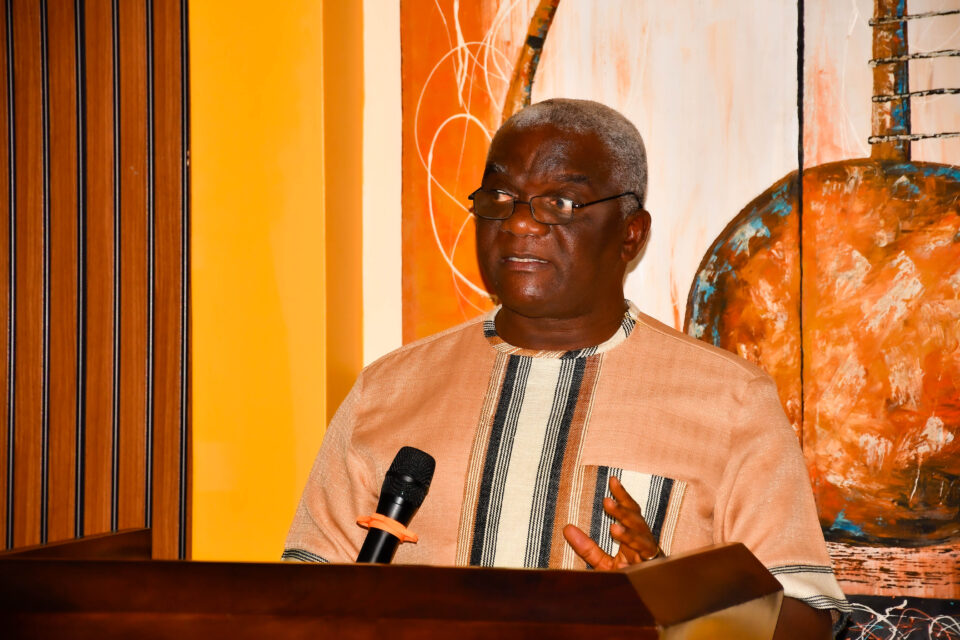
MONROVIA, Liberia — Liberia Revenue Authority Commissioner General James Dorbor Jallah has warned that illicit financial flows are depriving Liberia and other African countries of resources needed to fund public services, calling for a stronger regional campaign to trace hidden wealth and recover stolen assets.
Jallah spoke Tuesday at the opening of a regional training on asset recovery and illicit financial flows organized by the Liberia Anti-Corruption Commission and the African Union Advisory Board Against Corruption at the Cape Hotel in Monrovia.
The training, held under the theme “Implementing CAPAR and Curbing Illicit Financial Flows: Following the Money, Finding the Owner,” is focused on strengthening the ability of investigators and government institutions to follow complex financial transactions and identify those ultimately controlling hidden assets.
Jallah said Liberia must move beyond isolated investigations and build a coordinated system in which revenue, intelligence, law enforcement and anti-corruption agencies can share information within the limits of the law.
The LRA, he said, is positioned to detect financial irregularities through customs records, tax declarations and commercial transactions.
“At the Liberia Revenue Authority, we see the money when it first shows its face: at the port, at the border, on the tax return,” Jallah said.
He pointed to transactions in which invoices do not correspond with cargo and businesses that repeatedly report losses while continuing to expand as examples of patterns that can warrant closer scrutiny.
For Jallah, the issue is not simply about unpaid taxes. He said illicit financial flows can deepen inequality by allowing sophisticated financial arrangements to shift wealth away from the jurisdictions where it is generated, leaving ordinary taxpayers to carry a greater share of the burden.
“Africa is not poor. Africa is being drained,” he said.
Jallah cited a 2020 UNCTAD estimate that Africa loses about US$88.6 billion annually through illicit financial flows, describing the figure as evidence of the enormous resources at stake.
A major challenge, he said, is determining who ultimately owns or controls companies and financial structures used to move money across borders.
Identifying ultimate beneficial owners, he argued, must therefore become central to financial investigations if authorities are to move beyond tracking transactions and establish who stands behind them.
The commissioner general also criticized the gap between the speed at which illicit funds can cross borders and the slower pace at which investigators often obtain information from foreign jurisdictions.
He called for faster African cooperation in tracing money, freezing suspicious assets and pursuing their recovery.
Jallah identified the Common African Position on Asset Recovery (CAPAR) as an important framework for coordinating efforts to trace, freeze, recover and return illicitly acquired assets.
Within Liberia, he urged closer cooperation among the Liberia Anti-Corruption Commission, Financial Intelligence Agency, Ministry of Justice, Liberia National Police, Liberia Drug Enforcement Agency, National Security Agency, National Lottery Authority and the LRA.
He argued that recovering illicit assets could also strengthen Liberia’s fiscal position at a time when governments across Africa face pressure to finance development while managing limited domestic resources.
“Every dollar recovered strengthens our fiscal space and reduces the pressure to finance development through borrowing,” Jallah said.
He linked the issue to basic public needs, arguing that money recovered from illicit activities can ultimately support healthcare, education, roads and other essential services.
Jallah also framed the fight against illicit financial flows as part of Africa’s longstanding push for greater economic self-reliance.
“In 2026, self-reliance means one thing above all: keeping Africa’s money in Africa and bringing home what was stolen,” he said.
The commissioner general challenged participants to strengthen their ability to investigate complex financial transactions, uncover beneficial ownership structures, handle digital evidence and trace assets across jurisdictions.
The training is expected to enhance the capacity of Liberian and African institutions to investigate financial crimes and pursue the recovery of assets linked to illicit financial flows.
