
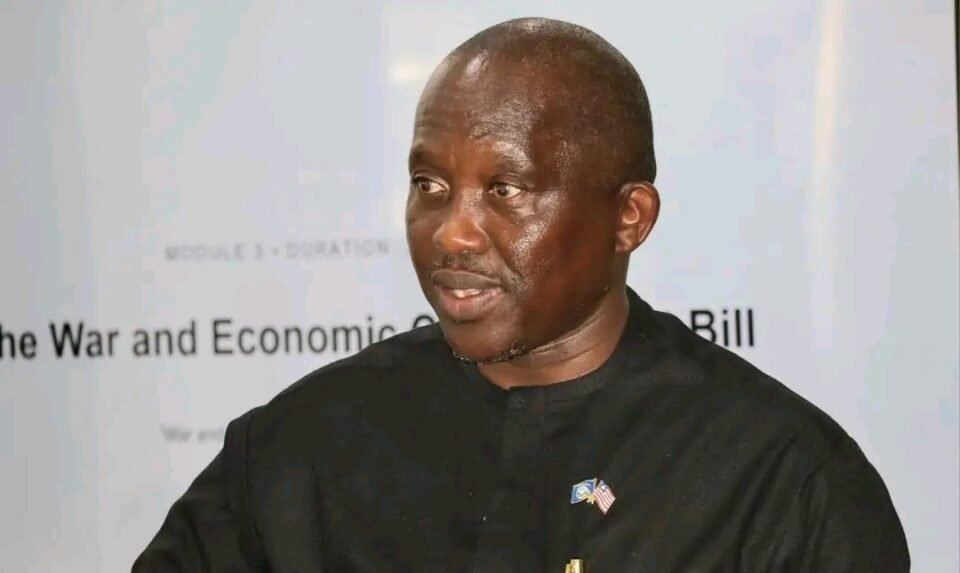
MONROVIA, Liberia — Executive Director of the Office of the War and Economic Crimes Court for Liberia, Cllr. Jallah Barbu, has rejected a Senate hearing scheduled for Wednesday, November 25, 2026, protesting a proposed ten-minute engagement that he considers inadequate for addressing an issue of major national importance.
Barbu described the proposed hearing as an attempt to delay the process, questioning how an issue as consequential as Liberia’s pursuit of justice for wartime atrocities could receive meaningful consideration within such a limited period.
Making his position clear, the head of the court’s administrative office ruled out participating in what he considers an unnecessarily restricted engagement with the Senate.
“I am not going in any small room with the Senate to do the Liberia people business,” Barbu stated.
His objection comes as Liberia continues to face longstanding demands for accountability for serious crimes committed during its civil wars, which devastated communities, claimed thousands of lives and left lasting consequences for survivors and their families.
A Long-Standing Demand for Accountability
The proposed War and Economic Crimes Court is intended to address one of Liberia’s most difficult unresolved national issues: accountability for atrocities committed during the country’s armed conflicts.
Throughout the civil wars, civilians endured widespread violence, including killings, torture, sexual violence, forced displacement and the recruitment and use of children in armed groups. Many victims never received justice, while families continue to seek answers about the fate of loved ones.
For years, local and international human rights advocates, survivors and civil society organizations have called for a credible judicial mechanism to investigate and prosecute individuals suspected of bearing responsibility for serious violations of international humanitarian and human rights law.
The court is expected to provide a formal legal avenue for examining these allegations and holding individuals accountable where sufficient evidence establishes criminal responsibility.
Its establishment would also carry significant implications for Liberia’s justice system, particularly in demonstrating that individuals accused of grave crimes must answer before the law, regardless of their political influence, former positions or connections.
Beyond Prosecution: The National Importance of the Court
The importance of the proposed institution extends beyond criminal proceedings. It also concerns the rights of victims, the preservation of historical truth and the country’s efforts to build lasting peace.
For survivors and families affected by wartime atrocities, the prospect of formal investigations and judicial proceedings offers an opportunity for their experiences to receive legal recognition.
A credible court could help establish an official record of crimes committed during the conflicts, provide a platform for victims and witnesses to participate in proceedings and strengthen public confidence in Liberia’s commitment to the rule of law.
However, the process must meet established standards of judicial independence, due process, fair trials and witness protection. Allegations must be tested through evidence, and every accused person must enjoy the presumption of innocence until proven guilty.
The court’s credibility will ultimately depend on its ability to operate independently, apply the law fairly and resist political interference.
Senate Engagement Under Scrutiny
The Senate hearing was expected to provide an opportunity for lawmakers to engage Barbu on issues concerning the court’s development and the responsibilities of his office.
As part of Liberia’s legislative framework, the Senate has an important role in considering matters requiring legislative action, exercising oversight and examining institutional arrangements affecting national governance.
Given the court’s potential financial, legal and institutional implications, engagement between the Legislature and the office responsible for advancing its establishment remains significant.
However, Barbu’s rejection of the proposed ten-minute session has introduced uncertainty surrounding Wednesday’s scheduled hearing.
His position raises questions about whether the Senate will reconsider the proposed duration and format to accommodate a more comprehensive discussion.
At stake is an initiative that has remained central to Liberia’s post-war accountability debate for decades.
For victims who have waited years for justice, the establishment of the War and Economic Crimes Court represents more than another government initiative. It is tied to their demands for accountability, recognition and the assurance that the suffering endured during the country’s civil wars will not remain without legal consideration.
The Senate’s next steps and any response from Barbu’s office are likely to shape the immediate direction of the engagement.
