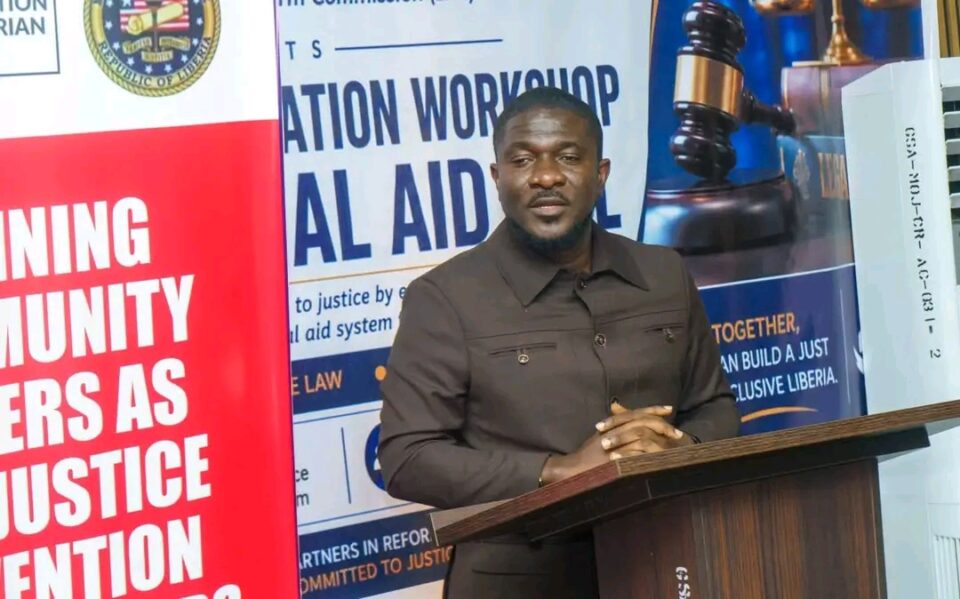
MONROVIA – Assistant Minister for Litigation at the Ministry of Justice, Atty. Siaffa Bahn Kemokai II, has issued a strong warning against mob violence, declaring that citizens who attack suspected criminals risk facing prosecution for serious offenses, including murder, manslaughter, aggravated assault, and civil lawsuits.
Delivering a keynote address during the Federation of Liberian Youth’s Anti-Mob Ambassadors training, organized in collaboration with the Ministry of Justice, Kemokai emphasized that no allegation or suspicion gives citizens the legal authority to punish another person outside the judicial system.
Speaking on the theme, “The Law Versus the Mob: Criminal and Civil Liabilities,” the legal expert reminded participants that Liberia’s Constitution guarantees every accused person the right to due process, regardless of the nature of the allegation.
He illustrated the dangers of mob justice by describing a scenario in which an individual accused of theft is chased, beaten, and killed by a crowd, only for the allegedly stolen property to later be found elsewhere.
”An accusation is not evidence. Suspicion is not conviction. Anger is not authority. And a crowd is not a court,” Kemokai declared.
According to him, Articles 20 and 21 of the Liberian Constitution protect every individual’s right to life, liberty, security, legal representation, and the presumption of innocence until proven guilty by a competent court.
Kemokai stressed that even individuals accused of committing crimes retain fundamental legal rights, including protection against torture, degrading treatment, unlawful detention, and extrajudicial punishment.
He warned that anyone who participates in mob attacks could face criminal charges depending on the extent of their involvement. Those who strike victims, provide weapons, block escape routes, encourage violence, or otherwise facilitate attacks may all be held criminally liable under Liberia’s Penal Law.
The Assistant Minister explained that mob violence can lead to charges ranging from simple assault and aggravated assault to manslaughter, negligent homicide, or murder where a victim dies.
He dismissed the common defense that an individual only struck the victim once or did not inflict the fatal injury, noting that the law recognizes criminal responsibility for aiding, encouraging, or facilitating the commission of crimes.
Beyond criminal prosecution, Kemokai cautioned that perpetrators of mob violence also face civil liability, allowing victims or their families to seek compensation for medical expenses, lost income, pain and suffering, permanent disability, wrongful death, and other damages.
He further clarified widespread misconceptions surrounding citizens’ arrest, stressing that private citizens have no legal authority to interrogate, torture, publicly humiliate, or punish suspects.
According to him, any intervention by civilians must be strictly limited to preventing immediate harm and promptly handing suspects over to the Liberia National Police using only the minimum force necessary.
Kemokai urged participants to distinguish lawful intervention from unlawful punishment, noting that while citizens may assist in preventing ongoing crimes, they cannot replace the courts.
Addressing the newly trained Anti-Mob Justice Ambassadors, he called on them to educate their communities about due process, discourage mob violence, preserve evidence, protect suspects and complainants alike, and encourage citizens to report criminal activity to law enforcement rather than taking the law into their own hands.
He concluded by reminding participants that justice can only be administered through the courts. “The law may restrain a suspect, but only a court may punish an offender,” Kemokai said, warning that mob justice often turns innocent people into victims and participants into criminal suspects while undermining Liberia’s justice system.
A CROWD IS NOT A COURT’ — JUSTICE MINISTRY WARNS MOBS FACE MURDER, CIVIL LIABILITY