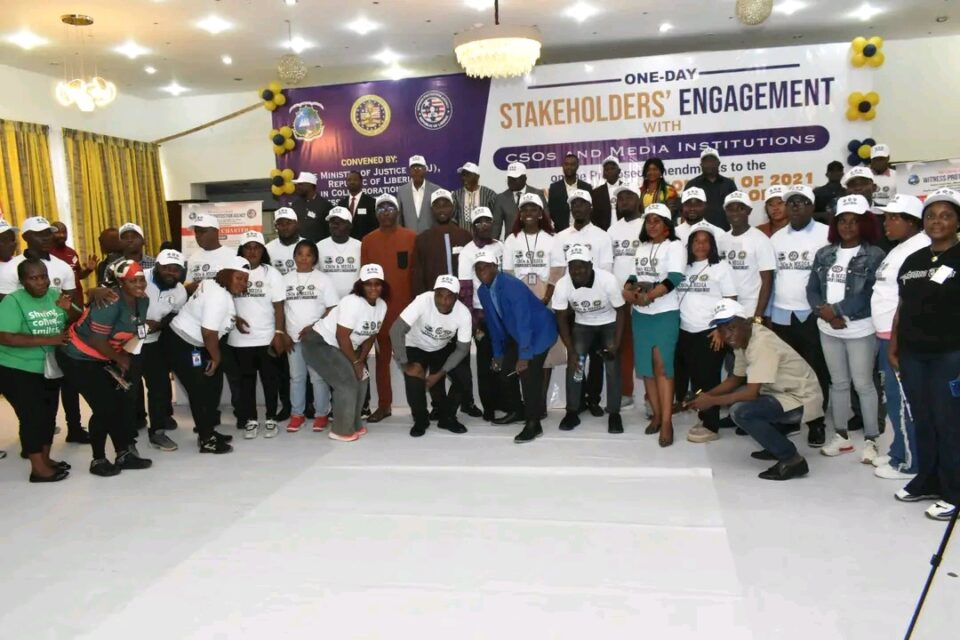
Monrovia, Liberia – The Government of Liberia has intensified efforts to strengthen the country’s anti-corruption and justice systems with the review of two key pieces of legislation aimed at providing stronger legal protection for witnesses, whistleblowers, and victims.
The Ministry of Justice, in collaboration with the Liberia Anti-Corruption Commission (LACC) and the Witness Protection Agency (WPA), convened a one-day stakeholders’ engagement at Monrovia City Hall to review proposed amendments to the Witness Protection Act of 2021 and the Whistleblower Act of 2021.
The consultation, held under the theme, “Strengthening Protection Mechanisms for Witnesses, Whistleblowers, and Victims: Advancing Liberia’s Anti-Corruption and Transitional Justice Commitments,” brought together representatives of government institutions, civil society organizations, media institutions, development partners, and members of the legal community.
According to the Ministry of Justice and its partners, the review is intended to address legislative and operational gaps identified during the implementation of both laws while strengthening Liberia’s capacity to combat corruption, organized crime, human rights violations, and support the country’s transitional justice agenda.
The proposed amendments seek to expand legal protections for witnesses, whistleblowers, and victims by strengthening confidentiality safeguards, improving institutional coordination, clarifying eligibility for protection, and introducing tougher penalties for retaliation against individuals who provide information to law enforcement authorities.
The reforms also propose increasing whistleblower rewards from five percent to ten percent, introducing bounty provisions to encourage the reporting of corruption, organized crime, smuggling, and other serious offenses.
Additional provisions include criminalizing retaliation against protected persons, prohibiting the unauthorized disclosure of protected identities, strengthening safeguards against digital surveillance, improving confidentiality measures, and requiring employers to comply with whistleblower protection requirements.
Delivering the keynote address, Attorney General and Minister of Justice, Cllr. N. Oswald Tweh, described the review process as a national priority essential to strengthening public confidence in Liberia’s justice system.
”A witness who will not speak, a whistleblower who will not report, and a victim who will not come forward are not isolated failures of personal courage. They are indictments of institutional failure, and this nation can no longer afford that failure,” Cllr. Tweh said.
He noted that although the Witness Protection Act and the Whistleblower Act represented significant milestones, experience from their implementation has revealed important legal and operational shortcomings that now require legislative reforms.
According to the Justice Minister, the proposed amendments are also intended to align Liberia’s legal framework with international obligations under the United Nations Convention against Corruption, the Rome Statute of the International Criminal Court, and the United Nations Convention against Transnational Organized Crime.
Speaking during the consultation, Atty. Teklo Maxwell Grigsby II, Director of the Witness Protection Agency, emphasized that protecting witnesses and whistleblowers is fundamental to the fight against corruption and the successful administration of justice.
Grigsby called on civil society organizations and the media to continue serving as partners in promoting accountability while exercising professionalism in protecting the identities of vulnerable witnesses.
”Civil Society and the Press are the frontline guardians of accountability in the Republic of Liberia. Hold us accountable, ask the hard questions, and walk this road together with us,” he stated.
He also encouraged the Press Union of Liberia to develop professional reporting guidelines that balance investigative journalism with the protection of witnesses and whistleblowers whose safety could be compromised through unauthorized disclosures.
Also addressing the gathering on behalf of the Executive Chairperson of the Liberia Anti-Corruption Commission, Vivian S. Akoto stressed that citizens will only report corruption if they are confident that the government can protect them from retaliation.
She emphasized that effective anti-corruption efforts require not only strong legislation but also adequate resources, institutional independence, and sustained political commitment.
The consultation also featured remarks from representatives of the Governance Commission, the Office for the Establishment of the War and Economic Crimes Court (OWECC), the Liberian National Bar Association, the United Nations Office of the High Commissioner for Human Rights (OHCHR), civil society organizations, and development partners.
At the close of the meeting, stakeholders agreed to establish a Witness and Whistleblower Protection Coordinating Platform to strengthen collaboration between government institutions, civil society organizations, and the media.
Recommendations from the consultation will be consolidated into a stakeholder report to guide the final draft of the proposed amendments before they are submitted to the National Legislature.
Participants concluded that stronger legal protections for witnesses, whistleblowers, and victims are essential to combating corruption, promoting accountability, advancing transitional justice, and reinforcing public confidence in Liberia’s justice system.
Liberia Moves to Strengthen Protection for Witnesses, Whistleblowers and Victims