
By Pewu Y. Sumo
MONROVIA, Liberia — In a major step toward deepening civic engagement and institutionalizing state-civil society collaboration, the Governance Commission (GC) and the National Civil Society Council of Liberia (NCSCL) officially launched the Implementation Strategy for the GOL/CSO Accord and Partnership Policy Framework on Friday, September 25, 2026, in Monrovia.
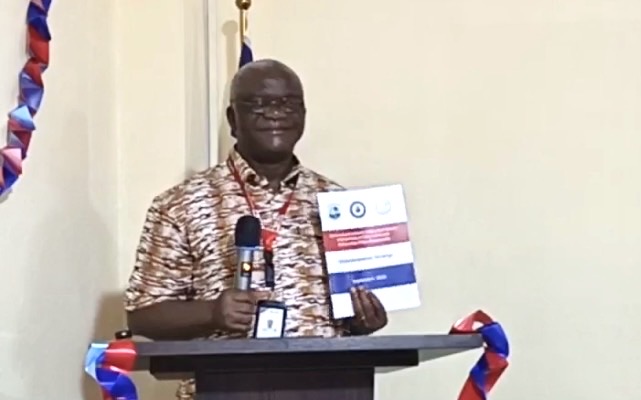
Serving as the chief launcher, Liberia Revenue Authority (LRA) Commissioner General James Dorbor Jallah noted that while the initial accord was signed in 2016 following a decade of consultations, the newly launched implementation strategy serves as a critical bridge turning long-held promises into actionable commitments.
“An accord signed is just a promise, and an accord implemented is a partnership,” Jallah stated as he officially unveiled the framework strategy, calling on all state and non-state actors to ensure the agreement translates into practical governance reforms across the nation.
“For 10 years, we have had a promise. This strategy is the bridge to that partnership.”
The newly launched strategy establishes a structured, accountable roadmap designed to elevate the implementation of the accord’s provisions from less than 20% to 80% by 2027.
Core pillars of the policy include protecting civic space, institutional governance, decentralized registration, and domestic resource mobilization.
Addressing why he was selected as chief launcher, Jallah emphasized that long-term civic sustainability must rely on internal domestic revenue generation rather than shrinking foreign aid.
Delivering welcome remarks, GC Executive Director Jallah C. Kesselly praised the growing collaboration between civil society organizations and his institution, calling it essential for the advancement of society.
“Our gathering here today is a manifestation of such an undertaking, where the government and its constituents can come to one accord,” Kesselly noted, adding that the dialogue represented a collective effort aimed at moving the country forward.
Meanwhile, the Acting Chairman of the GC, Prof. Alaric Tokpa, commended development partners for their timely response in honoring the Commission’s call. Highlighting the GC’s core mandate, Tokpa emphasized that the accord remains an essential tool for holding the government accountable to its citizens.
For his part, NCSCL Chairman Lawrence Yealue dispelled common public stereotypes, describing the widespread belief that civil society actors are merely agitators and government officials are universally corrupt as a “myth.”
Yealue argued that civil society actors only resort to forceful engagement when spaces for constructive dialogue are toxic, closed, or denied. He also defended upright public servants, asserting that individuals of high integrity continue to serve within government.
“Not all government officials can be thought of as corrupt because, like in the civil space and all other sectors, there are people still working with integrity,” Yealue stated. “However, a paradigm has developed where we have given bad actors a bigger platform in this country than good people.”
The event concluded with the official sign-off and distribution of the implementation roadmap to civil society leaders and government representatives. With the framework now officially operationalized, stakeholder monitoring teams are expected to begin county-level engagements to track progress toward the 2027 implementation targets nationwide.
