
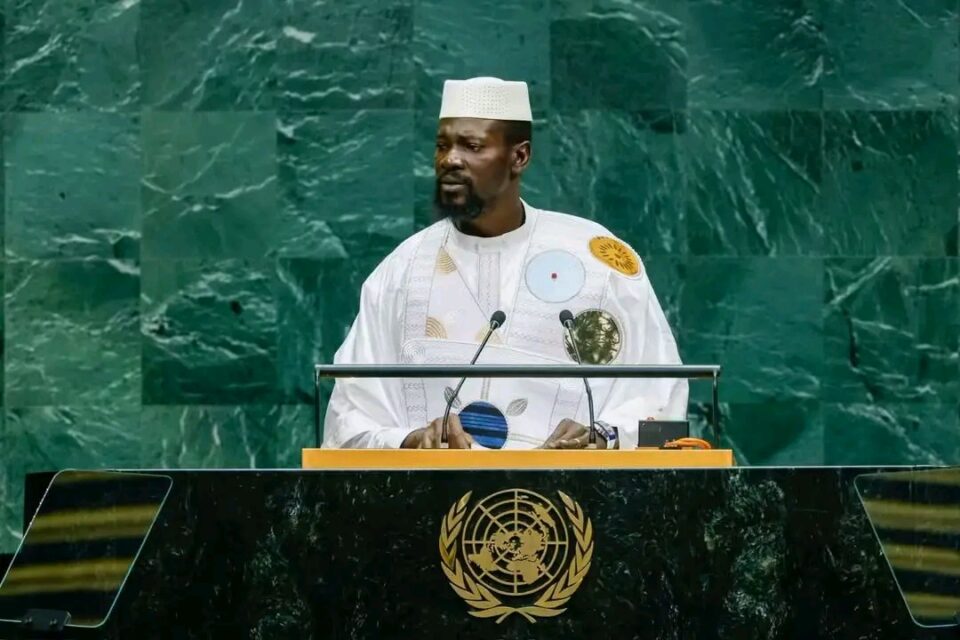
NEW YORK — President Mamadi Doumbouya of the Republic of Guinea has used his address to the 81st United Nations General Assembly to defend his government’s development approach, saying the country has adopted a governance model shaped by its own historical, social and cultural realities.
Addressing world leaders, President Doumbouya said Guinea’s experience demonstrates that African countries can pursue development through systems adapted to their national circumstances rather than relying exclusively on models developed elsewhere.
He said Guinea has adopted a new Constitution that, according to his government, strengthens representation, promotes participatory governance and recognizes the country’s linguistic, religious and cultural diversity.
President Doumbouya also said Guinea has completed its electoral cycle under the new constitutional framework, including presidential, legislative and local elections, with the process financed entirely by the Guinean Treasury.
He further claimed that the elections were conducted peacefully across the country without significant incidents involving electoral stakeholders.
Doumbouya Highlights Infrastructure and Mining Projects
The Guinean leader used the address to outline what he described as key achievements recorded under his administration.
Among the projects he highlighted were more than 1,000 kilometers of paved roads, new schools and hospitals, three alumina refineries under construction and what he described as Africa’s largest gold refinery.
He also highlighted the Simandou project, describing it as the largest mining and infrastructure project in Africa and a major component of Guinea’s economic transformation agenda.
According to Doumbouya, the government has developed the Simandou 2040 program as a 15-year development framework covering infrastructure, agriculture, energy, education, healthcare and industrialization.
He said the initiative is intended to move Guinea beyond the export of raw mineral resources by expanding domestic processing and investment.
Youth at the Center of Development Agenda
President Doumbouya identified Guinea’s young population as the country’s most important long-term asset.
He said his government intends to expand access to quality education and skills training while creating greater opportunities for employment and entrepreneurship.
He specifically referenced the Simandou Academy initiative as part of efforts to provide training aligned with labor-market needs.
Calls for Greater Respect for National Choices
In one of the central arguments of his speech, Doumbouya called for greater recognition of national differences when development and governance models are considered.
He pointed to countries in Asia and the Middle East that, he said, adapted international experiences to their own circumstances while pursuing rapid economic transformation.
“Africa can, too, follow this path,” Doumbouya said, while stressing that his position should not be interpreted as a rejection of international cooperation.
Instead, he called for what he described as a renewed partnership based on mutual respect, national sovereignty and cooperation between countries.
Guinea Pledges Continued International Cooperation
Doumbouya said Guinea would remain open to cooperation with the international community while maintaining what he described as respect for national sovereignty.
He told the UN General Assembly that Guinea’s development strategy is being pursued in accordance with international law and the principles of the United Nations Charter.
The Guinean president concluded by saying his country’s experience could contribute to a wider discussion about the different development paths available to African nations.
He said Guinea is moving forward through its own choices and resources while remaining committed to cooperation with international partners.
